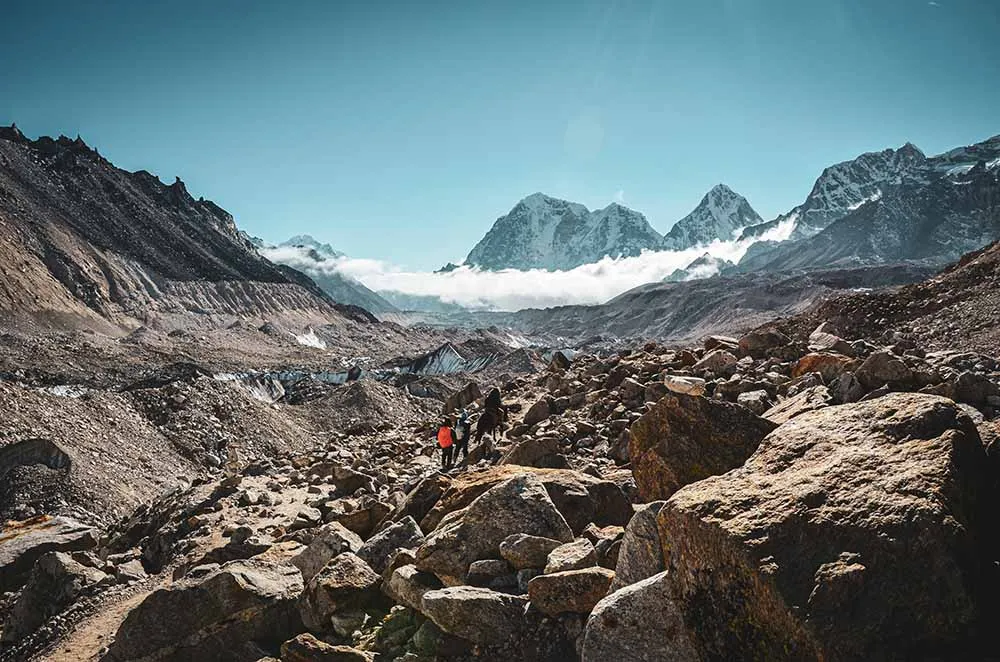
Birds of Nepal: Annapurna & Chitwan
A 16-day birding circuit from Kathmandu's Phulchauki rim through the Annapurna mid-hills — Kande, Ghandruk, Ulleri — down to Chitwan's sal forest and oxbow wetlands. Mixed broadleaf and cloud forest above 2,000 m; sal and grassland on the Terai floor. Max-8 group, naturalist-led, with a post-trip species list compiled from the trip leader's records.
About this trek
This is a 16-day itinerary that strings together three habitats and walks — rather than drives — between the elevation bands, which is how a bird list of any depth gets built. It opens at Lower Phulchauki on the Kathmandu valley rim, broadleaf cloud forest reached from the Godawari side. It then moves west into the mid-hill mixed broadleaf and rhododendron forest of the Annapurna foothills: Kande, Thulokot, Ghandruk, Bhaisi Kharka, Deorali, Ulleri, Tirkhedhunga, Birethanti. It closes on the sal forest, grassland, and oxbow wetlands of Chitwan National Park.
The Annapurna Conservation Area records well over 400 bird species; Chitwan logs over 650. We do not promise a number off those totals — a 16-day mixed-habitat trip with a naturalist leader and scope typically yields 150–250 species, depending on season and weather, and we publish each trip's actual list in the post-trip report. The pace is easy to moderate: short walking days, mostly under six hours, with frequent stops for the scope. One steep climb to Ghandruk on day 6 and a long descent through Ulleri on day 8 are the only hard sections; nothing on the route goes above roughly 3,000 m.
In winter the return from Chitwan can include a riverside stop on the Trishuli to look for Ibisbill (Ibidorhyncha struthersii), a Himalayan-river specialist that moves down to lower gravel in the cold months. The group caps at 8 so a single scope serves everyone, and the leader is a Nepal-licensed naturalist who works the same circuit each season. Bring 8×42 or 10×40 binoculars, the Birds of Nepal field guide (Grimmett, Inskipp & Inskipp), a notebook, and a camera.
Trip Facts
- Best season
- March–May and October–February (June–September possible but wet)
- Group size
- 2–8 trekkers
- Total distance
- ~75 km
- Avg walking
- Under 6 hours; one steep climb to Ghandruk, one long descent through Ulleri
- Start / end
- Kathmandu → Kathmandu
- Accommodation
- Hotels (B&B) in Kathmandu and Pokhara; full board at Chitwan wildlife resort; full-board teahouses on the Annapurna trek
- Guides & porters
- English-speaking naturalist birding guide; porters with loads capped at 25 kg and staff insurance included
- Minimum age
- 12+
Trek Highlights
- Lower Phulchauki Hill on the Kathmandu valley rim — broadleaf cloud forest worked on day 2 before the trek begins
- The Kande → Ghandruk → Ulleri corridor through Annapurna mid-hill broadleaf and rhododendron forest, days 4–10, on foot the whole way
- Chitwan National Park sal forest, grassland, and oxbow wetland — days 11–13, by walk, jeep, and canoe
- Optional Trishuli riverside stop for Ibisbill (Ibidorhyncha struthersii) on the winter return only
- Critically Endangered White-rumped Vulture (Gyps bengalensis, IUCN CR) possible on open ridges and the Terai
- Group capped at 8 — one scope, one guide, one shared list, with a post-trip species report
Day-by-Day Itinerary
Met at the airport and transferred to your hotel. Trip briefing in the afternoon, with a run-through of the route and the species list ahead.
Book a Departure
No published departures right now — get in touch and we'll set up a private date.
Upcoming Departures
Spring & autumn 2026
1 departureCustom and private departures available year-round on request.
What's Included
- Private land transportation Kathmandu–Pokhara–Chitwan–Kathmandu
- Hotel accommodation (B&B) in Kathmandu and Pokhara; full board at the Chitwan wildlife resort
- Full-board teahouse stays on the Annapurna trek
- All wildlife activities in Chitwan (walk, jeep, canoe)
- National park and conservation area fees
- TIMS card and ACAP (Annapurna Conservation Area Permit)
- Chitwan National Park entry
- Naturalist / birding tour leader for the full 16 days
- Porter service and support
- Government tax and staff insurance
- Post-trip species list and trip report
Not Included
- Travel insurance
- Meals in Kathmandu and Pokhara
- Bottled drinks and beverages
- Items not listed under "What's Included"
Frequently Asked Questions
What's the highest point on the trek?
The walking route peaks around Deorali in the Ghorepani sub-range, at roughly 2,900 m. Nothing on the route goes above 3,000 m.
How many bird species can I realistically expect to see?
The Annapurna Conservation Area lists well over 400 species and Chitwan over 650. A 16-day mixed-habitat trip with a naturalist leader and a scope typically yields 150–250 species, depending on season and weather. We publish each trip's actual list in the post-trip report rather than promising a number up front.
Is the Ibisbill stop guaranteed?
No. The Trishuli detour on day 14 only runs in winter (Nov–Feb), when Ibisbill (Ibidorhyncha struthersii) move down to lower river gravel. We don't promise the bird — we promise the stop.
Are elephants used in Chitwan?
Wildlife activities on this itinerary are walk, jeep, and canoe. We do not run elephant-back safaris.
How fit do I need to be?
Easy to moderate. Walking days are mostly under six hours, with one steep climb to Ghandruk on day 6 and a long descent through Ulleri on day 8. There is no altitude above roughly 3,000 m.
What other wildlife might I see in Chitwan?
Greater One-horned Rhinoceros (Rhinoceros unicornis) is regularly seen. Bengal Tiger (Panthera tigris tigris) is present but sightings are rare. Rhesus Macaque, Grey Langur, Yellow-throated Marten, Common Leopard, Northern Red Muntjac, and Himalayan Black Bear are also recorded in the wider circuit.
What gear should I bring?
8×42 or 10×40 binoculars, a scope if you own one, the Grimmett/Inskipp Birds of Nepal field guide, a notebook, and a camera. Standard mid-hill trekking clothing — layers, a light rain shell, broken-in boots.
When is the best time to go?
March–May and October–February both work well. June–September is possible but wet, with monsoon cloud over the hills.
More treks like this

Bird and Red Panda Expedition — Eastern Nepal
A 16-day expedition through four eastern-Nepal habitats — Phulchowki above Kathmandu, Sindhuli Gadi, the Koshi Tappu wetland, and the Ilam hills — tracking red panda (Ailurus fulgens, IUCN Endangered) alongside resident and migratory birds including Sultan Tit (Melanochlora sultanea). Naturalist-led, small group, starts and ends in Kathmandu. Red panda sightings are not guaranteed.
Urban Birds of Kathmandu Valley
Urban Birds of Kathmandu is a flexible half-day to multi-day birding outing run inside the valley — forest edges, farmland, creeks, and scrub slopes 15–40 minutes from the city. Targets include the Spiny Babbler (Turdoides nipalensis), the only bird endemic to Nepal. Naturalist-led, with a post-trip checklist, using the Kathmandu-based bird guides we work with year-round.
Godawari & Phulchauki Birding
A one-day naturalist-led bird walk on the southern edge of the Kathmandu Valley — Godawari Community Forest at the base, with an optional second day climbing Phulchauki Hill (2,760 m). Subtropical and temperate forest; over 300 species recorded on the hill, 100+ logged on past single days. Max-8 group, led by a licensed birder. Sunday–Friday departures.