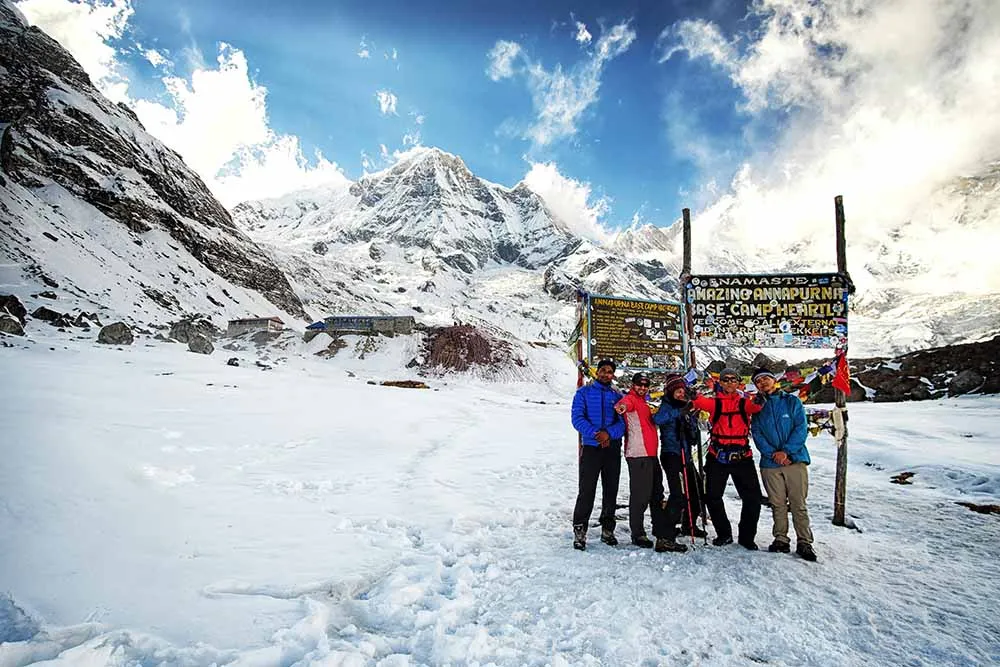
Annapurna Base Camp Trek
Walk through rhododendron forest and Gurung villages to the natural amphitheatre at the foot of Annapurna I — the world's tenth-highest mountain. Twelve days from Kathmandu, with a sunrise from Poon Hill, two nights inside the Sanctuary, and a hot-spring soak at Jhinu Danda on the way out. Lower than Everest Base Camp, equally beautiful, and the perfect first Himalayan trek.
About this trek
The Annapurna Sanctuary is one of those places that doesn't quite seem possible until you're standing in it. A near-perfect ring of 7,000 m and 8,000 m peaks — Annapurna I, Annapurna South, Hiunchuli, Gangapurna, the sacred fishtail summit of Machhapuchhare — encircling a high glacial basin at 4,130 m. Walk into it and the entire Himalayan range closes around you, 360 degrees, no horizon line at all. You're in the mountain, not just looking at it.
The route is a twelve-day loop from Pokhara, Nepal's lakeside second city. It starts gently — terraced rice fields, suspension bridges, stone-paved Gurung villages — climbs up to Poon Hill at 3,210 m for what's widely considered the finest sunrise in Nepal (Annapurna and Dhaulagiri turning gold simultaneously), then drops into the Modi Khola valley and follows the river up through rhododendron and bamboo forest into the Sanctuary itself. You'll spend two nights inside the amphitheatre — one at Machhapuchhare Base Camp, one at Annapurna Base Camp — to catch both sunset and sunrise on the peaks. On the way back, the trail finishes with a soak in the natural hot springs at Jhinu Danda, which is exactly as good as it sounds after eight days of walking.
The reason ABC is most people's first choice for a serious Himalayan trek is the maths. The high point is 4,130 m — high enough to be properly alpine, low enough that altitude sickness is rare with sensible pacing. There's no remote flight to a hilltop airstrip; you drive to the trailhead from Pokhara. The trail is well-supplied with comfortable family-run teahouses every two to three hours of walking. We've been running this trek out of Kathmandu since 2008, and our guides are local to the Annapurna region, mostly from the Gurung villages you'll walk through.
Trip Facts
- Best season
- March–May (spring) and September–November (autumn)
- Group size
- 2–12 trekkers
- Total distance
- ~70 km
- Avg walking
- 5–6 hours
- Start / end
- Nayapul (drive from Pokhara)
- Accommodation
- 3 nights tourist hotel (1 Kathmandu, 2 Pokhara); 8 nights in mountain teahouses, all twin-share
- Guides & porters
- Licensed Annapurna-region guide, plus 1 porter per 2 trekkers
- Minimum age
- 12+
Trek Highlights
- Stand at Annapurna Base Camp at 4,130 m (13,550 ft), inside a 360° amphitheatre of 7,000 m peaks — Annapurna I, Annapurna South, Machhapuchhare, Hiunchuli, Gangapurna
- Watch sunrise from Poon Hill (3,210 m), the most photographed sunrise in the Nepali Himalaya — Annapurna and Dhaulagiri ranges glowing gold at the same moment
- Walk through Gurung and Magar villages like Ghandruk, Chhomrong, and Tadapani — stone houses, slate roofs, terraced barley, working farms
- Pass through the gateway of Chhomrong into the Modi Khola valley and the Annapurna Sanctuary — one of the great walk-into moments in trekking
- End the trek with a hot-spring soak at Jhinu Danda, on the bank of the Modi Khola, before the final descent to the road
Day-by-Day Itinerary
Met at Tribhuvan International Airport and transferred to your hotel in Thamel. Get settled, take a hot shower, and meet your guide at the welcome dinner — a chance to go through the route, check gear, and ask questions. Accommodation: 3-star hotel in Kathmandu. Meals: Dinner.
Book a Departure
No published departures right now — get in touch and we'll set up a private date.
Upcoming Departures
Custom and private departures available year-round on request.
What's Included
- 2 nights' accommodation at a 3-star tourist hotel in Kathmandu (twin-share, B&B)
- 2 nights' accommodation at a 3-star hotel in Pokhara (twin-share, B&B)
- 8 nights' accommodation in mountain teahouses (twin-share)
- All meals on the trek (breakfast, lunch, dinner) — Nepali, Tibetan, and Western options
- One-way Kathmandu–Pokhara flight (return by flight, included)
- Private vehicle transfers: Pokhara–Nayapul–Pokhara
- Licensed, English-speaking trekking guide (Annapurna-region local)
- Porters (1 per 2 trekkers, 15 kg luggage allowance)
- All staff wages, meals, accommodation, insurance, and equipment
- All trekking permits: ACAP (Annapurna Conservation Area Permit) and TIMS card
- Half-day guided heritage tour of Kathmandu (Day 2)
- Airport transfers in Kathmandu
- Welcome and farewell dinners
- First-aid kit, oximeter, and emergency communications carried by guide
- All applicable government taxes
Not Included
- International flights to and from Kathmandu
- Nepal entry visa (USD $50 on arrival for 30-day multi-entry)
- Travel and medical insurance with high-altitude evacuation cover (mandatory — 5,000 m cover required)
- Lunches and dinners in Kathmandu and Pokhara beyond what's specified
- Drinks (bottled water, soft drinks, alcohol, tea/coffee outside meals)
- Hot showers and Wi-Fi in higher teahouses (typically USD $3–5 each, paid locally)
- Hot-spring entry fee at Jhinu (~USD $2)
- Personal trekking gear — gear list provided on booking
- Tips for guide and porters (customary; we'll advise)
- Costs arising from delays, evacuations, or events outside our control
- Anything not listed under "What's Included"
Frequently Asked Questions
How does ABC compare to Everest Base Camp?
The two most-asked-about treks in Nepal, often by the same person. The short answer:
If it's your first Himalayan trek and you're not sure how you'll handle altitude, ABC is the better choice. If you can spare 17 days and want the world's most famous trek, EBC.
How fit do I need to be?
Good general hiking fitness — capable of walking 5–6 hours a day for nine days, with a daypack of ~5 kg, on stone-paved trail and steep stairs. The Ulleri stairs (Day 4) are the single hardest section; everything after that is sustained but rarely brutal. We recommend training for 6–8 weeks before the trip with regular hill walks and cardio.
Will I get altitude sickness?
The high point of 4,130 m is below the threshold where altitude sickness becomes common. The itinerary is designed with a sensible ascent rate, and your guide carries a pulse oximeter. Mild headaches at ABC are common; serious altitude sickness is rare. Drink lots of water (4 L/day above 3,000 m), avoid alcohol, and tell your guide if you feel unwell — don't push through.
When should I go?
October and November are peak — clearest skies, most reliable weather, the longest queues at Poon Hill. March, April, and early May are the second peak, with the bonus of rhododendron flowering through the lower valleys. December–February is cold but quiet, with snow at ABC and clear views (some teahouses close). June–September is monsoon — leeches in the forest, clouds covering the peaks, and frequent flight delays; not recommended.
Where do we sleep?
Family-run teahouses every night on the trail. Twin-share rooms with simple beds, shared bathrooms in most villages, hot showers available for a small fee at lower elevations (limited or absent at Deurali, MBC, and ABC). All meals are taken in the teahouse dining room around a stove — this is also where you meet the other trekkers who become friends for the duration.
What about food?
The teahouses on the ABC route serve some of the best trail food in Nepal — partly because the trail is well-supplied, partly because Pokhara competition keeps standards up. Daily staples: dal bhat (refillable, local, what the porters eat), Tibetan momos, fried noodles and rice, soups, eggs, porridge, pancakes, and usually pizza/pasta at lower elevations. Above 3,500 m the menu simplifies but the dal bhat is still excellent.
Do I really need a guide?
Yes — and not just because it's now legally required. The trail is well-marked, but the guide handles permits, teahouse bookings (in October–November this matters), weather decisions, navigation in poor visibility, and altitude monitoring. They also know the families running each teahouse, which usually means better food, better rooms, and a hot shower when the next group is told they're out.
Is the hot spring actually good?
Yes. It's not a luxury spa — it's three concrete pools fed by hot mineral springs, on the bank of the Modi Khola, fifteen minutes' walk down a forest trail from Jhinu village. About USD $2 entry. After eight days of walking, it is genuinely transformative. Bring swimwear.
Can I extend the trip?
Common add-ons: 3 nights in Chitwan National Park (jungle safari, rhinos, occasionally tigers), an extra 2–3 days in Pokhara (paragliding, Phewa Lake, World Peace Pagoda), or a follow-on trek like Mardi Himal (4–5 days from Pokhara) or Ghorepani Poon Hill (3 days, if your group splits and some skip ABC).
What's the cancellation policy?
A 25% deposit confirms your booking. Full balance due 60 days before departure. Cancellations 60+ days out: full refund minus deposit. 30–59 days out: 50% refund. Less than 30 days out: no refund. We strongly recommend trip insurance with cancellation cover.
More treks like this
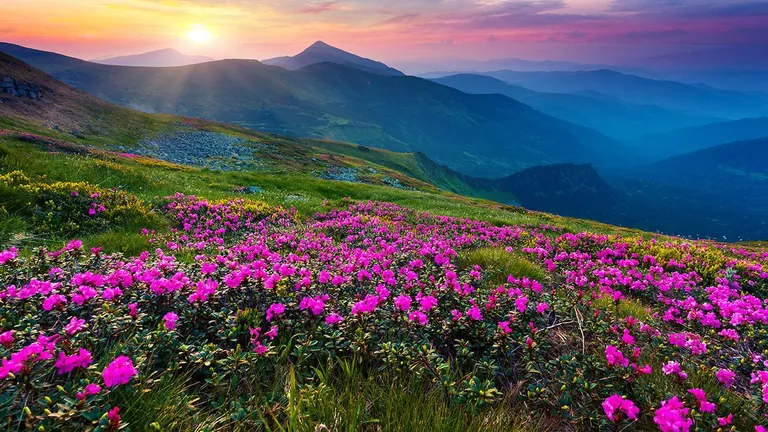
Rhododendrons of Milke Danda
A 16-day botanical walk from Basantapur to Tumlingtar along the Tinjure–Milke–Jaljale ridge in east Nepal's Koshi hills, topping out around 3,200 m on Milke Danda. Expect rhododendron forest in bloom — Rhododendron arboreum among them — and mid-hill cloud forest, not megafauna. Small group (min 4), naturalist-led, walking through Basantapur, Chauki, Gupha Pokhari, Milke Danda, and Khandbari.

Langtang Bird Trek
A walk-in birding trek through Langtang National Park, north of Kathmandu, with habitats running from riverside creeks to alpine pass. Park records list 380 bird species, ten of them globally threatened. The route names Ibisbill (Ibidorhyncha struthersii) on the Langtang Khola and crosses to Gosainkunda. Naturalist-led, locally-owned teahouses, IPPG-aligned porters.
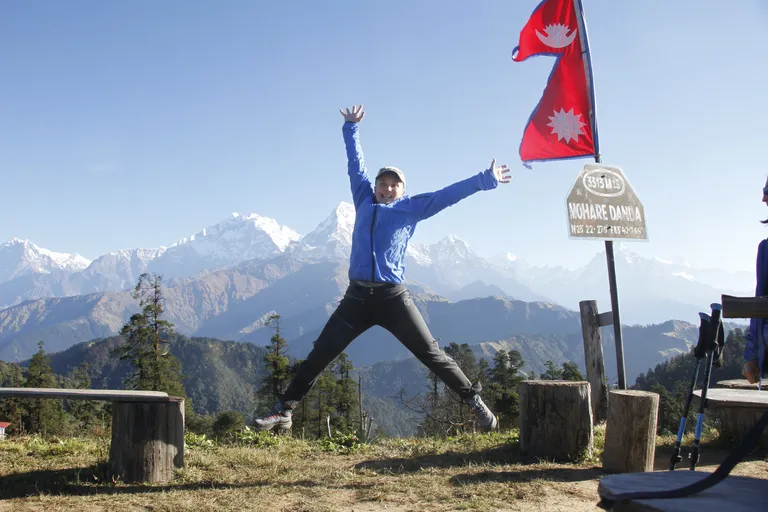
Mohare Danda Community Eco Trek
Mohare Danda is an 11-day trip from Kathmandu with six days walking through Magar villages in Myagdi, topping out at 3,300 m on Mohare Hill for an Annapurna–Dhaulagiri panorama. Expect rhododendron forest, terraced millet and buckwheat, and community-owned lodges in Bas Kharka, Nangi, Mohare, Danda Kharka, and Tikot — a quieter ridge west of Poon Hill.