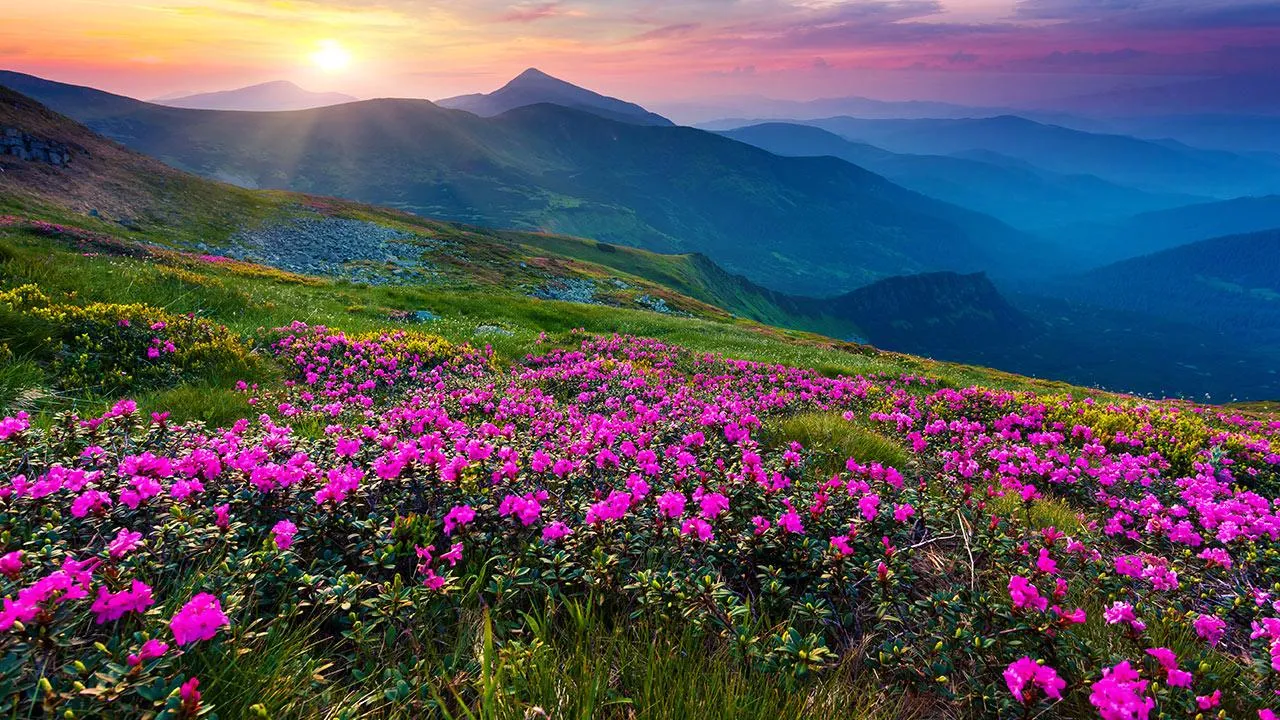
Rhododendrons of Milke Danda
A 16-day botanical walk from Basantapur to Tumlingtar along the Tinjure–Milke–Jaljale ridge in east Nepal's Koshi hills, topping out around 3,200 m on Milke Danda. Expect rhododendron forest in bloom — Rhododendron arboreum among them — and mid-hill cloud forest, not megafauna. Small group (min 4), naturalist-led, walking through Basantapur, Chauki, Gupha Pokhari, Milke Danda, and Khandbari.
About this trek
This is a flora-led trek, not a wildlife expedition. The route follows the Tinjure–Milke–Jaljale ridge — a long, north–south spine in east Nepal's Koshi hills, often called Nepal's "capital of rhododendrons" for the density and diversity of species it carries between roughly 2,500 m and 3,500 m. The walk starts at Basantapur after a flight to Biratnagar and a road transfer, climbs through Chauki (2,700 m) and Gupha Pokhari (2,900 m) to Milke Danda (3,200 m), then descends through Nundhaki, Chainpur, and Khandbari to the airstrip at Tumlingtar.
The headline species on this trail is Rhododendron arboreum — Nepal's national flower, the lali gurans — which forms whole canopies of red bloom in April. The live source claims "30 species of rhododendrons" along the ridge; we will not repeat that figure without a botanist-verified list (TBC). Other common ridge species — R. campanulatum, R. barbatum — are not confirmed by the source and remain TBC before publication. Expect mid-hill cloud forest, terraced Limbu and Rai villages, and weather that turns fast above 3,000 m.
Trip Facts
- Best season
- Mid-April to May (rhododendron bloom window)
- Group size
- 4–12 trekkers
- Total distance
- ~70 km
- Avg walking
- 5–7 hours (estimated — operator to confirm)
- Start / end
- Basantapur (via Kathmandu–Biratnagar flight and road) → Tumlingtar
- Accommodation
- Tented camping on trek; hotel in Kathmandu (B&B)
- Guides & porters
- Licensed naturalist guide; porter max load 25 kg (IPPG)
- Minimum age
- 12+
Trek Highlights
- _Rhododendron arboreum_ (lali gurans, Nepal's national flower) in canopy bloom along the Milke Danda ridge — peak window mid-April to early May
- Tinjure–Milke–Jaljale ridge walk between roughly 2,700 m (Chauki) and 3,200 m (Milke Danda)
- Cloud forest and mid-hill ecology of the Koshi catchment — not the high Himalaya
- Limbu and Rai village landscapes through Chainpur and Khandbari
- A named rhododendron species count to be published once botanist-verified (source says ~30; figure TBC)
- Tented camping on the ridge, with no permanent infrastructure built or used by us
Day-by-Day Itinerary
Met at the airport and transferred to your hotel.
Book a Departure
No published departures right now — get in touch and we'll set up a private date.
Upcoming Departures
Spring 2026 (bloom window)
1 departureCustom and private departures available year-round on request.
What's Included
- All meals on trek and tented accommodation
- Licensed naturalist guide
- Domestic flights (Kathmandu–Biratnagar return)
- Private ground transport
- Half-day guided Kathmandu heritage tour
- Kathmandu hotel (bed & breakfast)
- Staff insurance and state tax
Not Included
- Lunch and dinner in Kathmandu
- Welcome dinner
- Nepal visa and airport tax
- Personal travel insurance
- Tips
- Bottled drinks
Frequently Asked Questions
Is this a red panda or Kanchenjunga trek?
No. Despite the old URL slug, this trek is a botanical walk along the Tinjure–Milke–Jaljale ridge in east Nepal's Koshi hills. It does not enter the Kanchenjunga Conservation Area and we do not advertise red panda sightings on it. If you want red panda tracking, see our Red Panda Tracking tour.
When do the rhododendrons actually bloom?
Peak bloom for Rhododendron arboreum on this ridge is mid-April to early May, based on the source itinerary. Higher-elevation species shift later. Dated bloom-window observations from our own past departures are TBC.
How many species will we see?
The live page claims 30 species along the ridge. We will not repeat that figure until a botanist-verified species list is in hand. Confirmed on-route so far: Rhododendron arboreum. Others TBC.
How fit do I need to be?
Moderate. Daily walking of 5–7 hours on ridge trail with sustained climbs to 3,200 m. There are no technical sections; altitude is modest by Nepal standards, but consecutive days above 2,500 m require base hill-walking fitness.
Where do we sleep?
Tented camp on the ridge, with no permanent infrastructure built or used by us, plus a hotel at each end in Kathmandu. Named host-family partners along the Basantapur–Chainpur–Khandbari corridor are TBC.
What permits are needed?
The ridge sits outside the Kanchenjunga Conservation Area proper; a local rural-municipality entry fee likely applies, and the TIMS requirement for this route is to be verified (TBC).
Why is the region tagged differently?
Our regional taxonomy does not currently carry a Koshi-hills / east-Nepal mid-hill region, so this trek is filed under a placeholder pending confirmation (TBC).
More treks like this

Bird and Red Panda Expedition — Eastern Nepal
A 16-day expedition through four eastern-Nepal habitats — Phulchowki above Kathmandu, Sindhuli Gadi, the Koshi Tappu wetland, and the Ilam hills — tracking red panda (Ailurus fulgens, IUCN Endangered) alongside resident and migratory birds including Sultan Tit (Melanochlora sultanea). Naturalist-led, small group, starts and ends in Kathmandu. Red panda sightings are not guaranteed.
Nepal Wildlife — Chitwan & Bardia
A 12-day naturalist-led tour through Chitwan and Bardia National Parks — Nepal's sal-lowland and riverine-forest terai. Game-spotting is on foot, by jeep, and by dugout canoe, never on captive elephants. Max-12 group, full-board lodges next to the parks, and a park-licensed naturalist on every drive and walk. Bookended by the Kathmandu Valley and a half-day at Lumbini.
Snow Leopard Tracking — Nar Phu - Manang
A trans-Himalayan expedition of 18 days into the Nar Phu valley behind the Annapurna massif, tracking snow leopard (Panthera uncia, IUCN Vulnerable) and its blue sheep prey (Pseudois nayaur). Naturalist-led, with a community wildlife tracker on every expedition. Nar Phu is a restricted area; passes here sit above 5,000 m. Sightings are not guaranteed — come for the landscape, treat the cat as a bonus.