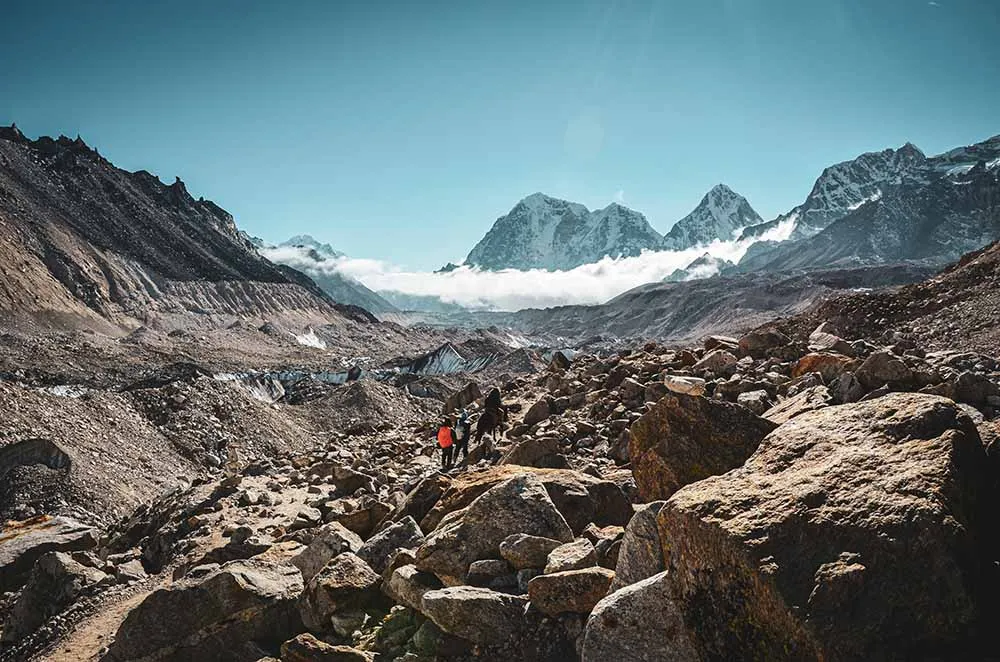
Manaslu Delight
A 20-day circuit around Mount Manaslu (8,163 m), the world's eighth-highest peak and one of Nepal's most remote restricted-area treks. Cross the Larkya La pass at 5,106 m, walk into Tibetan-border villages at Sama Gaon and Samdo, and trek a route that only opened to foreigners in 1992. Less crowded than Everest BC, more demanding than Annapurna BC, deeper culturally than either.
About this trek
The Sherpas call it Kutang. To the wider world it's Manaslu — Manasa, "the spirit," "the soul." At 8,163 metres it's the eighth-highest mountain on Earth, the highest peak in the Mansiri Himal, and arguably the most strikingly proportioned of Nepal's eight-thousanders. A Japanese expedition led by Toshio Imanishi and Gyalzen Norbu first stood on its summit in May 1956, three years after Hillary and Tenzing on Everest. The valley below, however, stayed closed. It wasn't until 1992 that the Nepalese government opened the trail around the mountain to foreign trekkers, and it remains a designated restricted area today — special permit, licensed guide, minimum two trekkers, no exceptions.
The route is a complete circuit. You start at Soti Khola in the foothills west of Kathmandu, walk up the Budi Gandaki river through subtropical gorges and terraced rice fields, climb gradually into oak and rhododendron forest, then alpine pasture, then the high arid country of the Tibetan plateau. The villages along the way change as you climb — Hindu Gurung settlements at the bottom, Tibetan Buddhist communities at the top, with chortens, prayer wheels, and the kind of mani walls that took someone a lifetime to carve. Sama Gaon and Samdo, two days from the high pass, are the cultural heart of the trek: Tibetan-border villages where the families speak Tibetan in their kitchens and yak-herding is still the main occupation. From there you cross the Larkya La pass at 5,106 m, descend through the Bimthang glacier amphitheatre, and finish in the Marshyangdi valley where the trail meets the Annapurna Circuit road.
This is a serious trek. It's longer than Everest Base Camp, technically more sustained than Annapurna Base Camp, and the Larkya La crossing is a real high-pass day with 1,000 m of climbing in thin air. But it's not a mountaineering route — there's no climbing, no ropes, no crampons except in occasional spring snow. What it asks for is fitness, proper acclimatisation, and a willingness to spend 14 days walking. What it gives back is what you came to Nepal for in the first place: an actual circuit (not an out-and-back), genuine remoteness, and the feeling that the mountain you're walking around is doing something to you.
We've been operating Manaslu since the trail opened to foreigners. Our founder, Vimal Thapa, has personally led more than thirty Manaslu circuits, and our guides for this trek are all from the Manaslu region — most from villages on the trail itself. Because the area is restricted, we run smaller groups (10 maximum, 4 minimum) and only on fixed dates with proper logistics for permits, transport in (the road to Soti Khola is rough), and contingency for the high-pass day.
Trip Facts
- Best season
- September–November (autumn) and March–May (spring)
- Group size
- 4–10 trekkers
- Total distance
- ~177 km
- Avg walking
- 6–7 hours
- Start / end
- Soti Khola (8-hour drive) → Bhulbhule / Besisahar (drive back)
- Accommodation
- 3 nights tourist hotel in Kathmandu; 14 nights in mountain teahouses (lower-quality at higher elevations)
- Guides & porters
- Licensed Manaslu-region guide (mandatory by law), 1 porter per 2 trekkers
- Minimum age
- 16+
Trek Highlights
- Circle Mount Manaslu (8,163 m / 26,781 ft), the world's eighth-highest peak — the Mountain of the Spirit, summited only in 1956 by a Japanese expedition
- Cross the Larkya La pass at 5,106 m / 16,752 ft — one of the great Himalayan high passes, with views of Himlung, Cheo, Annapurna II, and Kang Guru
- Walk into Sama Gaon and Samdo, traditional Tibetan-border villages of yak-herders, monasteries, and stone houses unchanged in centuries — the cultural heart of the trek
- Visit Pungyen Gompa, a 600-year-old monastery overlooking the Manaslu glacier — optional acclimatisation hike from Sama Gaon
- Trek a genuine restricted-area trail that only opened to foreigners in 1992 and still requires a special permit — meaningful remoteness, not marketed remoteness
- Walk an actual circuit — different valley out than in, different scenery every day, no backtracking
Day-by-Day Itinerary
Met at Tribhuvan International Airport and transferred to your hotel in Thamel. Welcome dinner with your guide — go through the route, check gear, ask everything. Accommodation: 3-star hotel in Kathmandu. Meals: Dinner.
Book a Departure
No published departures right now — get in touch and we'll set up a private date.
Upcoming Departures
Custom and private departures available year-round on request.
What's Included
- 3 nights' accommodation at a 3-star tourist hotel in Kathmandu (twin-share, B&B)
- 14 nights' accommodation in mountain teahouses on the trek (twin-share)
- All meals on the trek (breakfast, lunch, dinner) — Nepali, Tibetan, and Western options
- Private 4WD transport: Kathmandu → Soti Khola (one way) and Tilje → Kathmandu (return)
- Licensed, English-speaking Manaslu-region trekking guide (mandatory under restricted-area regulations)
- Porters (1 per 2 trekkers, 15 kg luggage allowance)
- All staff wages, meals, accommodation, insurance, and equipment
- All three trekking permits: Manaslu Restricted Area Permit (RAP — USD $100/week in peak season, $75/week in off-season), Manaslu Conservation Area Permit (MCAP), and Annapurna Conservation Area Permit (ACAP)
- Permit processing — passport photos and document handling on your behalf
- Half-day guided heritage tour of Kathmandu (Day 2)
- Airport transfers in Kathmandu
- Welcome and farewell dinners
- First-aid kit, oximeter, and emergency communications carried by guide
- All applicable government taxes
Not Included
- International flights to and from Kathmandu
- Nepal entry visa (USD $50 on arrival for 30-day multi-entry)
- Travel and medical insurance with high-altitude evacuation cover (mandatory — minimum 6,000 m cover required for Larkya La)
- Lunches and dinners in Kathmandu beyond what's specified
- Drinks (bottled water, soft drinks, alcohol, tea/coffee outside meals)
- Hot showers and Wi-Fi in higher teahouses (typically USD $3–7 each at lower elevations, often unavailable above Sama Gaon)
- Personal trekking gear — sleeping bags and down jackets available to rent in Kathmandu
- Tips for guide and porters (customary; we'll advise — Manaslu tipping is typically higher than Annapurna treks given remoteness)
- Costs arising from delays, evacuations, or events outside our control
- Anything not listed under "What's Included"
Frequently Asked Questions
How does Manaslu compare to Everest BC and Annapurna BC?
If this is your first Himalayan trek, do EBC or ABC. Manaslu is for trekkers who've done one of those, want something harder and quieter, and want a circuit rather than an out-and-back.
How fit do I need to be?
This is a strenuous trek and you should arrive in genuine shape. Capable of walking 6–7 hours a day for 14 consecutive days, with a daypack of 5–7 kg, on uneven trail with sustained ascents and descents. Recent multi-day trekking experience is strongly recommended — Manaslu is not the right first big trek. The Larkya La crossing day involves 1,000 m of climbing in thin air, then 1,400 m of descent on tired legs. Train for at least three months: long-distance hill walks with weight, cardio, and some leg-strength work.
Can I trek Manaslu solo?
No. This is a legal restriction, not just a recommendation. The Manaslu region is a designated restricted area, which by Nepalese law requires a minimum of two foreign trekkers plus a licensed guide registered through a TAAN-member trekking agency. Solo trekking on this route is not permitted under any circumstances.
What permits do I need and how much do they cost?
Three permits are required, all of which we handle for you: - Manaslu Restricted Area Permit (RAP): USD $100/week (Sep–Nov peak season), USD $75/week (Dec–Aug). Most itineraries cost USD $175–$200 per person on this permit. - Manaslu Conservation Area Permit (MCAP): USD $30 per person. - Annapurna Conservation Area Permit (ACAP): USD $30 per person (required because the trek finishes in the Annapurna Conservation Area).
Total permit cost is around USD $235–260 per person. This is included in your trip price.
When should I go?
October and November are the peak — clearest skies, stable weather at altitude, and the best chance of an open Larkya La. March to May is the second peak — slightly more snow on the pass in early March, with rhododendron flowering through the lower valleys by April. December–February is possible but cold, with real snow risk on the Larkya La and some teahouses closed. June–September is monsoon — heavy rain in the lower valleys, leeches in the forest, frequent landslides on the road in. Not recommended.
Where exactly do we sleep?
Family-run teahouses every night on the trail. Twin-share rooms with simple beds and shared bathrooms in most villages. Standards drop with elevation: comfortable at Soti Khola and Machha Khola, basic at Lho and Sama Gaon, very basic at Samdo and Dharamshala (Larkya Phedi), where the lodge at Dharamshala is a single stone-built dormitory in a high basin. All meals are taken in the teahouse dining room around a wood/yak-dung stove.
What about food?
Teahouse menus are simpler than Annapurna or Everest — fewer Western options, more local. Daily staples: dal bhat (refillable, what the guides and porters eat), Tibetan momos and thukpa, fried rice, fried noodles, eggs, porridge, pancakes. Above Sama Gaon, the menu shrinks. At Samdo and Dharamshala, expect dal bhat, soup, and porridge. Dietary requirements work — vegetarian is straightforward; vegan is workable; gluten-free is hard above Lho.
What's the Larkya La crossing actually like?
Hard. Pre-dawn start (typically 4 a.m.) from Dharamshala in cold and dark with a headlamp, climbing steadily across moraine and (usually) snow for 4–5 hours to the prayer-flag-covered cairn at the top. The pass itself is wide and obvious, not a knife-edge — the difficulty is altitude, cold, and the long day. Descent is 4–5 hours of knee-pounding scree and stone, dropping nearly 1,400 m to Bimthang. Total day: 8–10 hours, 24 km, with major elevation change. Most people remember it for the rest of their lives.
Will I get altitude sickness?
The itinerary is designed with a sensible ascent profile and includes an acclimatisation day at Sama Gaon (3,520 m). The Larkya La crossing is the only day above 5,000 m. Mild altitude effects (headache, poor sleep, low appetite) are common from Lho upwards; serious altitude sickness is rare with sensible pacing. Your guide carries a pulse oximeter and checks oxygen saturation each evening. If anyone shows symptoms, the response is descent. Diamox prophylaxis is a personal decision — discuss with us and your doctor before the trip.
Why is this trek more expensive than EBC or ABC?
Three real reasons: 1. Restricted-area permits add USD $235–260 per person that EBC/ABC don't have. 2. Logistics are more involved — long 4WD transport at both ends, smaller group sizes (10 max vs typical 12), more porter/guide ratio because the trail is more remote. 3. Acclimatisation is built in with two buffer days in Kathmandu (Lukla flights for EBC have one; ABC has none) — Manaslu's high-pass day has more weather risk and we plan accordingly.
Can I extend the trip?
Yes. The most natural extension is Tsum Valley — a side-valley off the main Manaslu route, even more remote, deeply Tibetan Buddhist, and adds 5–7 days. Other common extensions: 3 nights in Chitwan (jungle safari), 3 nights in Pokhara (lakeside rest), or stay on at Bimthang and continue into the Annapurna Circuit if you have another two weeks.
What's the cancellation policy?
A 25% deposit confirms your booking. Full balance due 60 days before departure. Cancellations 60+ days out: full refund minus deposit. 30–59 days out: 50% refund. Less than 30 days out: no refund. Note: the Manaslu Restricted Area Permit fee (USD $100–200) is non-refundable once issued — if you cancel after permits are processed, this is deducted from any refund. We strongly recommend trip insurance with cancellation cover.
More treks like this
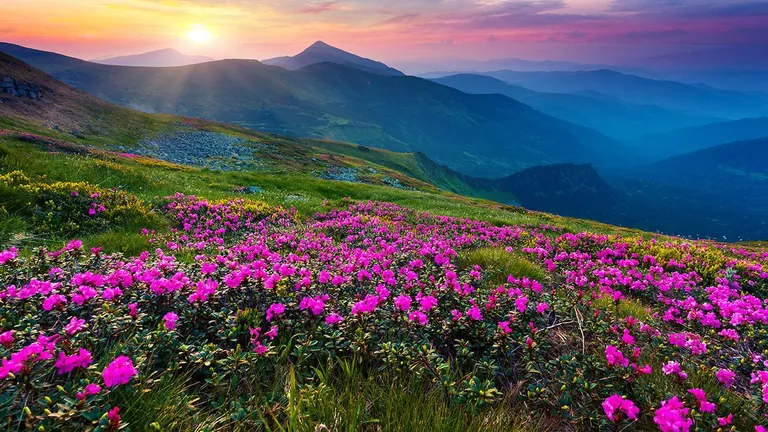
Rhododendrons of Milke Danda
A 16-day botanical walk from Basantapur to Tumlingtar along the Tinjure–Milke–Jaljale ridge in east Nepal's Koshi hills, topping out around 3,200 m on Milke Danda. Expect rhododendron forest in bloom — Rhododendron arboreum among them — and mid-hill cloud forest, not megafauna. Small group (min 4), naturalist-led, walking through Basantapur, Chauki, Gupha Pokhari, Milke Danda, and Khandbari.

Langtang Bird Trek
A walk-in birding trek through Langtang National Park, north of Kathmandu, with habitats running from riverside creeks to alpine pass. Park records list 380 bird species, ten of them globally threatened. The route names Ibisbill (Ibidorhyncha struthersii) on the Langtang Khola and crosses to Gosainkunda. Naturalist-led, locally-owned teahouses, IPPG-aligned porters.
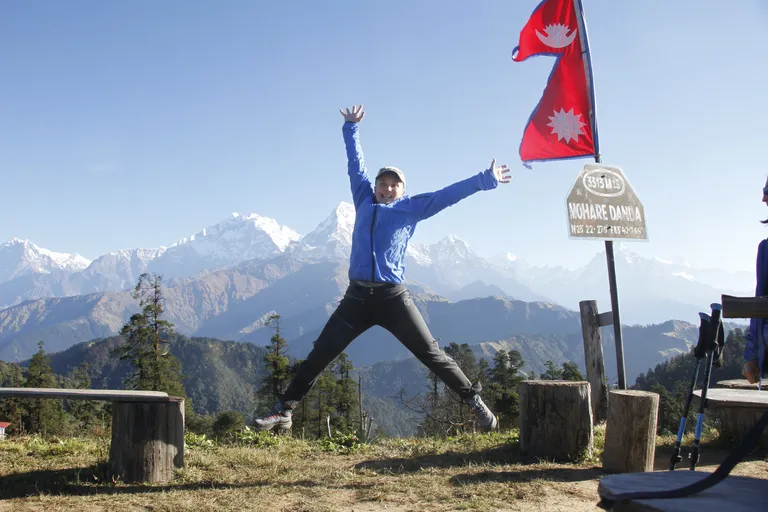
Mohare Danda Community Eco Trek
Mohare Danda is an 11-day trip from Kathmandu with six days walking through Magar villages in Myagdi, topping out at 3,300 m on Mohare Hill for an Annapurna–Dhaulagiri panorama. Expect rhododendron forest, terraced millet and buckwheat, and community-owned lodges in Bas Kharka, Nangi, Mohare, Danda Kharka, and Tikot — a quieter ridge west of Poon Hill.