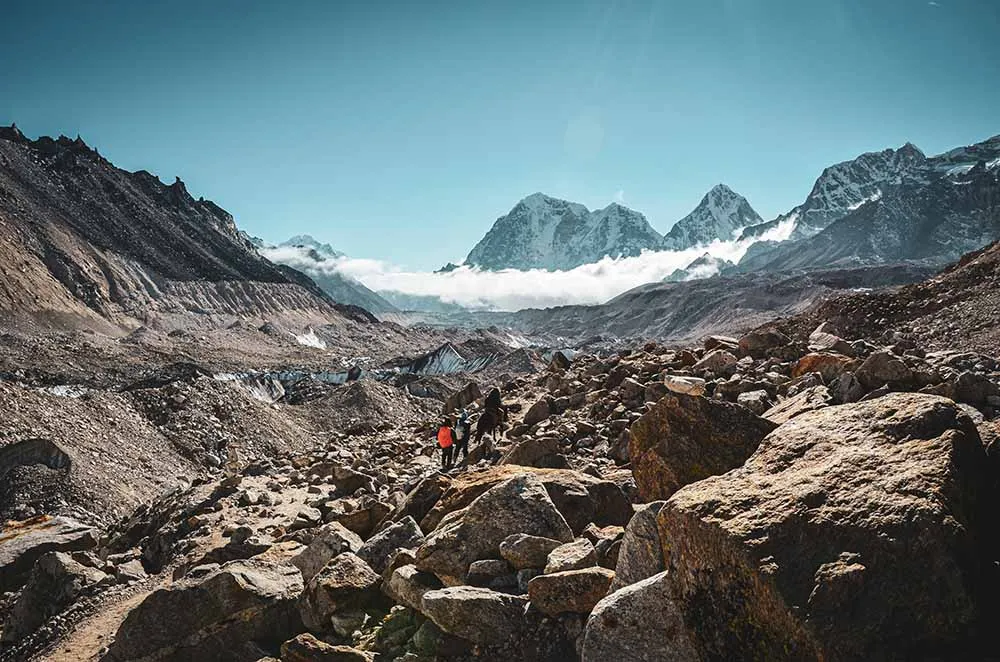
Snow Leopard Tracking — Nar Phu Valley
A trans-Himalayan expedition of 18 days into the Nar Phu valley behind the Annapurna massif, tracking snow leopard (Panthera uncia, IUCN Vulnerable) and its blue sheep prey (Pseudois nayaur). Naturalist-led, with a community wildlife tracker on every expedition. Nar Phu is a restricted area; passes here sit above 5,000 m. Sightings are not guaranteed — come for the landscape, treat the cat as a bonus.
About this trek
This is a trans-Himalayan wildlife expedition into the Nar Phu valley, Manang district — behind the Annapurna massif, not in Dolpo. The target species is the snow leopard (Panthera uncia, IUCN Vulnerable), known locally as the ghost of the mountains, alongside its primary prey, blue sheep (Pseudois nayaur). Nar Phu is a restricted area; the route requires a Nar Phu Restricted Area Permit and ACAP, and group sizes are constrained by the permit rules.
Snow leopards in the Nar Phu valley are not guaranteed. We will publish the count and years from our own past expeditions before booking opens (TBC) — until then we quote no probability. Our previous live page claimed an "approximately 90%" encounter rate; that figure had no methodology behind it and we have removed it. Snow leopard density in suitable habitat is widely cited at roughly one to three adults per 100 km²; we will publish the source-specific figure we use once verified (TBC). Come for the trans-Himalayan landscape, the blue sheep herds, and the alpine birdlife.
The expedition is led by a naturalist with wildlife-tracking experience, working with a community wildlife tracker (village / cooperative name TBC). We do not run captive-wildlife interactions, baiting, or any practice that habituates the cat to humans. Where we fall short: we have not yet published the tracker's name, the past-expedition sighting record, or our share of the permit fee that reaches the local conservation committee — all on our list to fix.
Trip Facts
- Best season
- Winter and early spring (best sighting odds); also Apr–May and Sep–Oct
- Group size
- 2–6 trekkers
- Total distance
- ~110 km
- Avg walking
- 5–7 hours, with rest and tracking days at altitude (estimated — operator to confirm)
- Start / end
- Kathmandu → Kathmandu (drive → Koto via Besisahar)
- Accommodation
- Boutique hotel in Kathmandu; full-service camping on expedition
- Guides & porters
- Naturalist guide plus local tracking partner, support staff; porter max load 25 kg (IPPG)
- Minimum age
- 16+
Trek Highlights
- Track snow leopard (Panthera uncia, IUCN Vulnerable) with a community wildlife tracker
- Blue sheep (Pseudois nayaur) herds — the snow leopard's primary prey
- Nar Phu restricted area — trans-Himalayan terrain north of the Annapurna massif
- Naturalist expedition leader with a wildlife specialism
- Himalayan alpine birdlife along the valley (target species list TBC)
- Tibetan-influenced villages of Nar and Phu — culture as the trip, not a backdrop
Day-by-Day Itinerary
Met at the airport and transferred to a boutique hotel. Expedition briefing and permit formalities.
Book a Departure
No published departures right now — get in touch and we'll set up a private date.
Upcoming Departures
Winter / early spring 2026
1 departureApr–May & Sep–Oct 2026
1 departureCustom and private departures available year-round on request.
What's Included
- Boutique hotel with breakfast in Kathmandu
- Half-day guided heritage sightseeing in Kathmandu
- All meals on expedition (breakfast, lunch, dinner, hot drinks)
- Camping gear and kitchen utensils
- Naturalist expedition leader with snow leopard / wildlife specialism
- Guide and support staff, plus a community wildlife tracker
- Special permits and nature conservation fees
- Private ground transportation
- Staff insurance and government tax
Not Included
- International and domestic flights
- Nepal tourist visa
- Travel and rescue insurance
- Personal trekking and cold-weather gear
- Tips for guide, tracker, porters, and kitchen crew
- (Full exclusions list to be finalised — TBC)
Frequently Asked Questions
What are the realistic odds of seeing a snow leopard?
Snow leopards in Nar Phu are not guaranteed, and we will not quote a number until we publish our own past-expedition record (TBC). The cat is genuinely elusive — that is what "ghost of the mountains" means. Winter and early spring offer better odds, because blue sheep concentrate at lower elevations and snow shows tracks.
Is this the Dolpo snow leopard trek?
No. This expedition runs in the Nar Phu valley, Manang district — north of the Annapurna massif. A Dolpo snow leopard expedition is a separate product we do not yet offer; it is on our roadmap.
Who is the wildlife tracker?
A community wildlife tracker from a Nar Phu village (name TBC). We do not yet publish the tracker's name on the website — we will once we have their consent to do so.
Do you bait or habituate the cat for sightings?
No. No baiting, no captive interactions, no habituation practices. Sightings happen on the cat's terms or they do not happen.
How fit do I need to be?
Moderate to strenuous. Multiple days above 4,000 m, at least one pass crossing above 5,000 m (Kang La, approx. 5,320 m — estimated, to confirm), and camping in winter conditions for the high-probability sighting window. Prior high-altitude trekking experience is required.
What permits are needed?
A Nar Phu Restricted Area Permit (USD-denominated, seasonal pricing — current rate TBC) and the Annapurna Conservation Area Permit (ACAP). TIMS status for restricted-area routes is to be verified (TBC).
When is the best time to go?
Winter and early spring give the best sighting odds on the shorter version; April–May and September–October are also operable for the landscape and birdlife.
More treks like this

Bird and Red Panda Expedition — Eastern Nepal
A 16-day expedition through four eastern-Nepal habitats — Phulchowki above Kathmandu, Sindhuli Gadi, the Koshi Tappu wetland, and the Ilam hills — tracking red panda (Ailurus fulgens, IUCN Endangered) alongside resident and migratory birds including Sultan Tit (Melanochlora sultanea). Naturalist-led, small group, starts and ends in Kathmandu. Red panda sightings are not guaranteed.
Rhododendrons of Milke Danda
A 16-day botanical walk from Basantapur to Tumlingtar along the Tinjure–Milke–Jaljale ridge in east Nepal's Koshi hills, topping out around 3,200 m on Milke Danda. Expect rhododendron forest in bloom — Rhododendron arboreum among them — and mid-hill cloud forest, not megafauna. Small group (min 4), naturalist-led, walking through Basantapur, Chauki, Gupha Pokhari, Milke Danda, and Khandbari.
Nepal Wildlife — Chitwan & Bardia
A 12-day naturalist-led tour through Chitwan and Bardia National Parks — Nepal's sal-lowland and riverine-forest terai. Game-spotting is on foot, by jeep, and by dugout canoe, never on captive elephants. Max-12 group, full-board lodges next to the parks, and a park-licensed naturalist on every drive and walk. Bookended by the Kathmandu Valley and a half-day at Lumbini.